

Saluki: Complete Guide to Temperament, Health, Care & History
For over 5,000 years, the Saluki has been called “the shadow of the desert”—a silent, swift companion to pharaohs, sheikhs, and nomads across the Middle East. Revered in ancient Egypt (where mummified remains rest beside royalty), the Saluki is not just one of the world’s oldest dog breeds—it’s a living artifact of human-canine partnership.
Today, this large, elegant sighthound captivates with its flowing coat, gentle eyes, and quiet dignity. But behind its serene exterior lies a heart of intense loyalty and a body built for explosive speed.
In this definitive guide, you’ll learn everything you need to know about the Saluki: its history and cultural significance, physical traits, temperament, health vulnerabilities, exercise and grooming needs, and whether your lifestyle aligns with this noble breed. We’ll also compare it to close relatives like the Sloughi and Azawakh to clarify its unique place among desert sighthounds.
All information is rigorously cross-referenced with the American Kennel Club (AKC), Fédération Cynologique Internationale (FCI), Orthopedic Foundation for Animals (OFA), and historical records from the Middle East and North Africa.
Origin & History
The Saluki’s origins trace back to the Fertile Crescent—modern-day Iran, Iraq, Syria, Jordan, and Egypt—where archaeological evidence (including 7,000-year-old pottery and 4,000-year-old tomb paintings) confirms its status as a sacred hunting companion.
Unlike modern breeds shaped by kennel clubs, the Saluki was preserved by Bedouin tribes, who considered it a gift from Allah. It lived in tents, shared food, and was never sold—only gifted. Its role: hunting gazelle, hare, and fox using sight, speed (up to 42 mph), and endurance across vast deserts.
The breed reached Europe in the 19th century via British officers and diplomats. The UK Kennel Club recognized it in 1923, and the AKC followed in 1927—making it one of the first sighthounds registered in the U.S.
While often confused with the Sloughi (North Africa) or Azawakh (West Africa), the Saluki is distinct in geography, coat type, and temperament. It was bred across a wider region, leading to greater variation—especially in coat length.
Key fact: The FCI classifies the Saluki as “Gazelle Hound”, emphasizing its functional hunting heritage over aesthetics.
Physical Characteristics
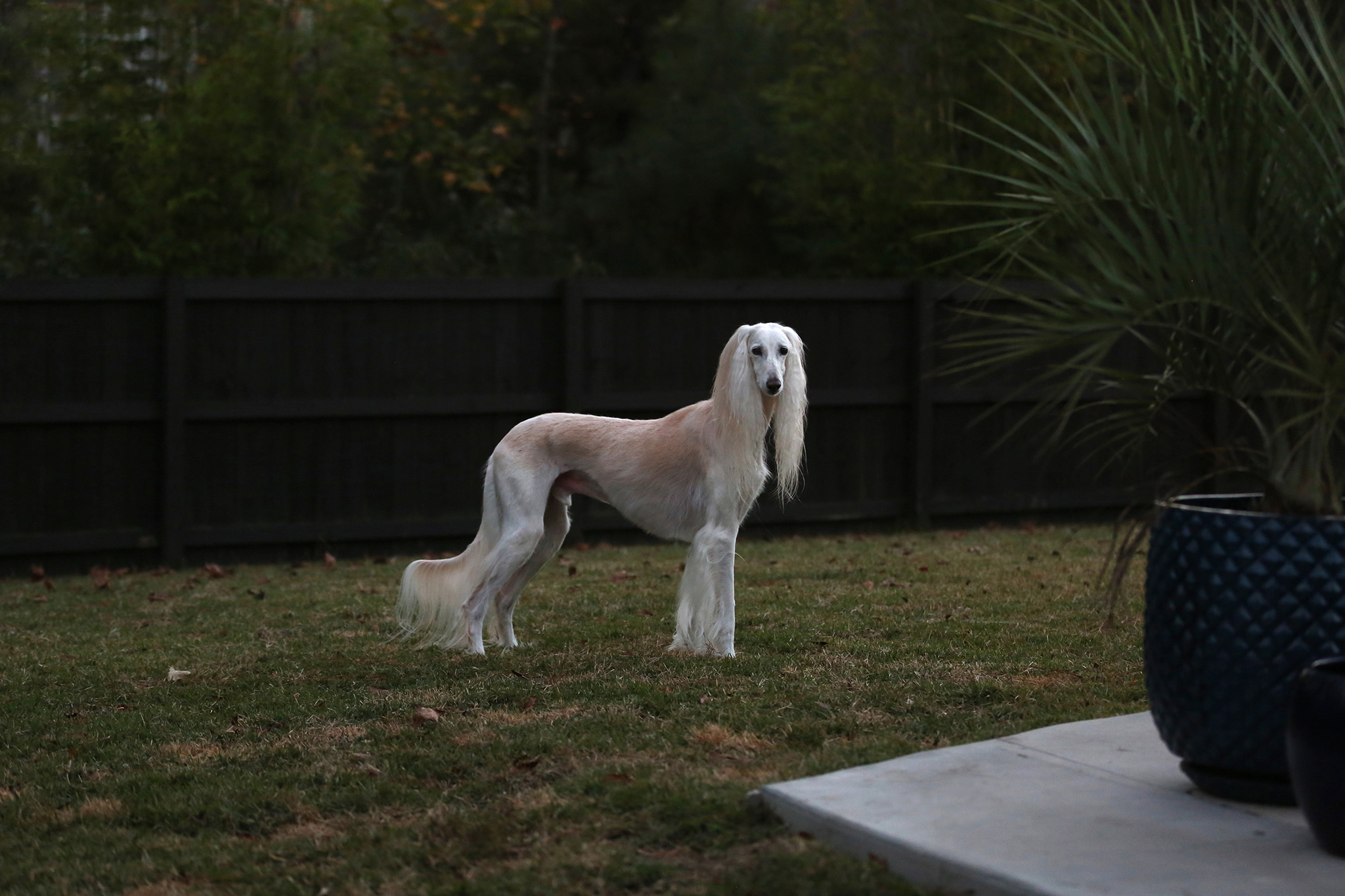
The Saluki is a large, graceful sighthound designed for speed, agility, and endurance in open terrain.
- Height:
- Males: 23–28 inches (58–71 cm)
- Females: 22–26 inches (56–66 cm)
(Per AKC and FCI)
- Weight: 40–65 lbs (18–29 kg)—similar to the Sloughi but often lighter-boned
- Coat Types: Two varieties:
- Smooth: Short, fine, and silky
- Feathered: Longer hair on ears, legs, tail, and thighs (more common in the West)
- Colors: White, cream, fawn, red, grizzle/tan, black & tan—never brindle or solid black
- Build: Deep but narrow chest, tucked abdomen, long legs, and a curved tail carried low
- Eyes: Large, dark, and soft—expressing gentleness and melancholy
- Ears: Long, pendant, covered in silky hair
The Saluki’s gait is effortless and floating, covering ground with minimal effort—a hallmark of elite coursing dogs.
Comparison: Unlike the Azawakh (angular, skin-tight) or Sloughi (masked, muscular), the Saluki has a more refined, flowing silhouette, especially in the feathered variety.
Temperament & Personality
The Saluki is gentle, sensitive, and deeply attached to its family—but reserved with strangers. It’s not aloof like the Azawakh, nor as quietly vigilant as the Sloughi; instead, it offers quiet companionship and emotional attunement.
- Affection: Forms strong bonds; often follows owners room to room
- Sensitivity: Reacts poorly to yelling or punishment; thrives on calm, positive reinforcement
- Prey drive: Extremely high—will chase squirrels, cats, or even leaves in motion
- Independence: Bred to hunt independently; may “choose” when to obey
- Quiet nature: Rarely barks; communicates through subtle body language
Unlike the Greyhound (which is more adaptable to casual households), the Saluki requires a stable, low-stress environment. It’s also more emotionally complex than the Whippet.
Note: Early socialization is essential to prevent timidity. The Saluki is not a “party dog”—it prefers calm over chaos.
Care Requirements
Exercise
The Saluki needs daily opportunities to run freely in a securely fenced area (minimum 6 feet tall). Leash walks alone won’t satisfy its instinct to sprint. Lure coursing or open-field chasing is ideal.
Despite its energy, it’s calm indoors and often described as “cat-like” in its lounging habits.
Grooming
- Smooth variety: Weekly brushing
- Feathered variety: 2–3 times weekly to prevent mats on ears and legs
- Baths only as needed—its skin is delicate
- Regular dental care and nail trims are essential
Diet
High-quality, moderate-protein diet with omega fatty acids to support coat health (especially in feathered types). Avoid overfeeding—Salukis carry little body fat.
Environment
Adaptable to temperate climates but sensitive to cold. Provide indoor access and a winter coat below 45°F (7°C). Not suited to outdoor-only living.
Comparison: Like the Sloughi, the Saluki thrives in quiet, secure homes—but its feathered coat demands slightly more grooming.
Health & Lifespan
Average lifespan: 12–17 years (one of the longest among large breeds)
The Saluki benefits from ancient genetics and natural selection, but modern breeding has introduced some concerns.
Condition | Description | Prevalence in Saluki | Symptoms / Notes |
|---|---|---|---|
Cardiomyopathy (DCM) | Enlarged, weakened heart | Moderate risk (documented in U.S. and UK lines) | Lethargy, coughing, collapse; annual cardiac screening recommended |
Hemangiosarcoma | Aggressive cancer of blood vessels | Higher than average in sighthounds | Often asymptomatic until advanced; no reliable screening |
Hypothyroidism | Underactive thyroid | Low to moderate (OFA data) | Weight gain, lethargy, skin issues; manageable with medication |
Pannus (Chronic Superficial Keratitis) | Autoimmune eye condition | Seen in some lines | Redness, cloudiness; requires lifelong eye drops |
Anesthetic Sensitivity | Due to low body fat and unique metabolism | High risk | Avoid acepromazine; use sighthound-safe protocols |
OFA data shows <2% hip dysplasia in tested Salukis—excellent for a large breed.
Reliable data on epilepsy or PRA in this breed is limited, though responsible breeders screen for eye and heart issues annually.
Training & Socialization
The Saluki learns quickly but questions repetitive or harsh methods. Training must be short, positive, and meaningful.
- Start socialization before 14 weeks: expose to varied people, sounds, and surfaces
- Use high-value rewards (boiled chicken, cheese)
- Focus on recall and impulse control—critical given its prey drive
- Off-leash freedom is only safe in fully enclosed areas
Compared to the Azawakh, the Saluki is more biddable; compared to the Sloughi, it’s slightly more adaptable—but still not ideal for novice owners.
Suitability: Ideal Owner Profile
The Saluki thrives with:
- Experienced, patient owners who understand sighthound sensitivity
- Calm, predictable households with older children or no kids
- Access to large, secure open space for running
- Owners who offer consistent companionship—this breed dislikes isolation
Not recommended for:
- First-time dog owners
- Homes with small pets (cats, rabbits, etc.)
- Loud, chaotic, or frequently changing environments
- Urban apartments without safe sprint options
Like the Sloughi, the Saluki suits those who value quiet elegance, deep loyalty, and ancient heritage.
Costs & Commitment
- Adoption: Rare; possible via sighthound rescues ($400–$900)
- Reputable breeder: $1,800–$3,000 (health-tested, ethically raised)
- Monthly expenses: $80–$120 (food, grooming, preventatives)
- Special costs: Fencing, winter coats, cardiac screenings
Lifetime cost estimate: $20,000–$28,000 over 14 years
Ethical Adoption vs. Breeder Guidance
Choose breeders who:
- Perform annual cardiac exams (Holter/echo) and OFA thyroid/eye certifications
- Raise puppies in-home with early socialization
- Are members of the Saluki Club of America (SCOA) or FCI clubs
- Prioritize working ability and temperament over show looks
Avoid online sellers, pet stores, or breeders who skip health testing. The Saluki’s legacy depends on ethical stewardship.
FAQs
1. Is the Saluki a large dog?
Yes—the Saluki is a large sighthound, typically 22–28 inches tall and 40–65 lbs.
2. Are Salukis good with cats?
Only if raised with them from puppyhood. Otherwise, their prey drive is overwhelming.
3. Do Salukis bark a lot?
No—they’re among the quietest breeds.
4. How much grooming does a feathered Saluki need?
2–3 brushings per week to prevent tangles on ears, legs, and tail.
5. Can Salukis be left alone all day?
Not ideally. They bond deeply and may develop anxiety or depression.
6. Saluki vs. Greyhound: which is better?
Greyhounds are more adaptable and couch-oriented; Salukis are more sensitive, independent, and culturally distinct.
7. How rare is the Saluki?
Uncommon but more available than the Azawakh or Sloughi—around 500 AKC registrations annually.
8. Are Salukis hypoallergenic?
No—but their minimal shedding may suit some allergy sufferers.
Final Verdict: Is the Saluki Right for You?
Yes, if…
- You seek a large, ancient, emotionally attuned companion
- You can provide secure sprint space and consistent companionship
- You’re experienced with sighthounds or sensitive breeds
- You appreciate history, elegance, and quiet devotion
No, if…
- You want a playful, child-centered, or highly obedient dog
- You live in a small space or very cold climate without accommodations
- You expect reliable off-leash recall or tolerance of small animals
- You’re a first-time owner
The Saluki isn’t just a dog—it’s a 5,000-year-old legacy of desert nobility, offering silent grace and unwavering loyalty to those who honor its nature.