
Irish Wolfhound: Complete Guide to Temperament, Health, Care & History
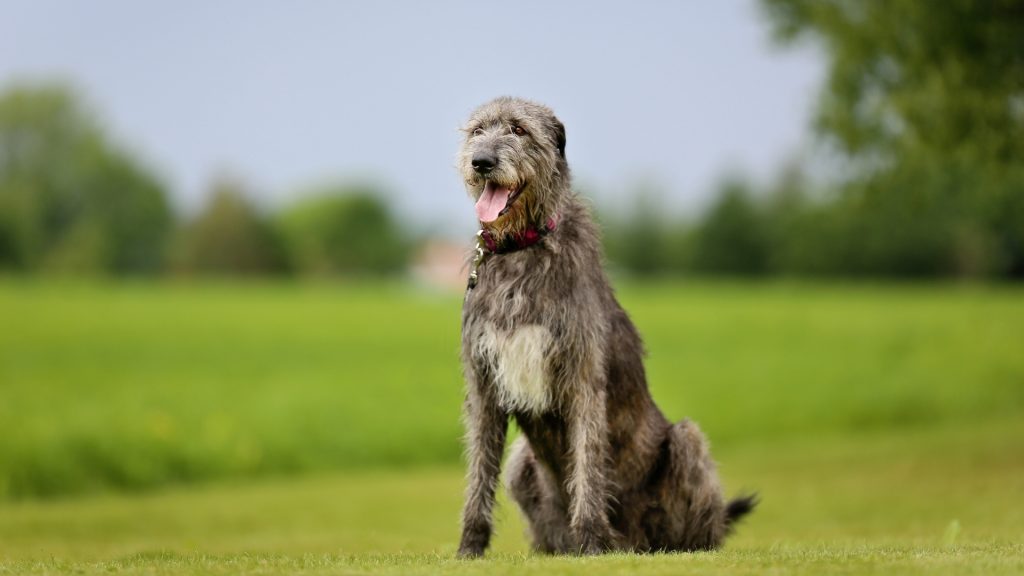
Standing over 32 inches tall and weighing up to 180 pounds, the Irish Wolfhound is the tallest of all dog breeds—a living monument to Celtic nobility and courage. Once used to hunt wolves and guard castles in medieval Ireland, this giant sighthound combines majestic size with profound gentleness, earning it the nickname “gentle giant of the Emerald Isle.”
Despite its warrior past, the modern Irish Wolfhound is best known for its calm, affectionate, and deeply loyal nature. It leans against its favorite humans like a soft, furry wall, follows them room to room with quiet devotion, and treats children with remarkable patience. Yet behind its serene demeanor lies a fragile reality: one of the shortest lifespans among purebreds and susceptibility to life-threatening conditions like bone cancer and bloat.
Not a casual pet but a high-commitment, high-reward companion, the Irish Wolfhound thrives only with owners who understand its needs for space, companionship, and vigilant health care.
In this comprehensive, rigorously researched guide, you’ll learn everything about the Irish Wolfhound: its ancient Irish origins, athletic build, gentle temperament, critical health vulnerabilities, moderate grooming needs, and whether your lifestyle can support this noble giant. We’ll also compare it to similar giant breeds like the Scottish Deerhound, Great Dane, and Borzoi to clarify its unique place among the world’s largest dogs.
All information is verified through the American Kennel Club (AKC), Irish Wolfhound Club of America (IWCA), Orthopedic Foundation for Animals (OFA), and historical Irish records.
Origin & History
The Irish Wolfhound’s legacy stretches back to Roman times, when the breed was so prized that the Romans demanded them as tribute from Celtic chieftains. By the Middle Ages, they were indispensable to Irish nobility, used to hunt wolves, elk, and even guard estates from invaders.
Their size and strength made them legendary—King John of England restricted ownership to nobles of high rank, and they were often gifted between royal courts as symbols of alliance.
By the 18th century, with wolves eradicated from Ireland, the breed nearly vanished. In the 1860s, British officer Captain George Augustus Graham saved it by crossbreeding remaining specimens with Great Danes, Deerhounds, and Borzois to restore size and type. The modern Irish Wolfhound is largely his creation.
The AKC recognized the breed in 1897, and today it remains a symbol of Irish pride and gentle strength.
Key distinction: Unlike the Scottish Deerhound (bred for red deer), the Irish Wolfhound was built for larger, more dangerous prey—wolves—requiring greater mass and power.
Physical Characteristics
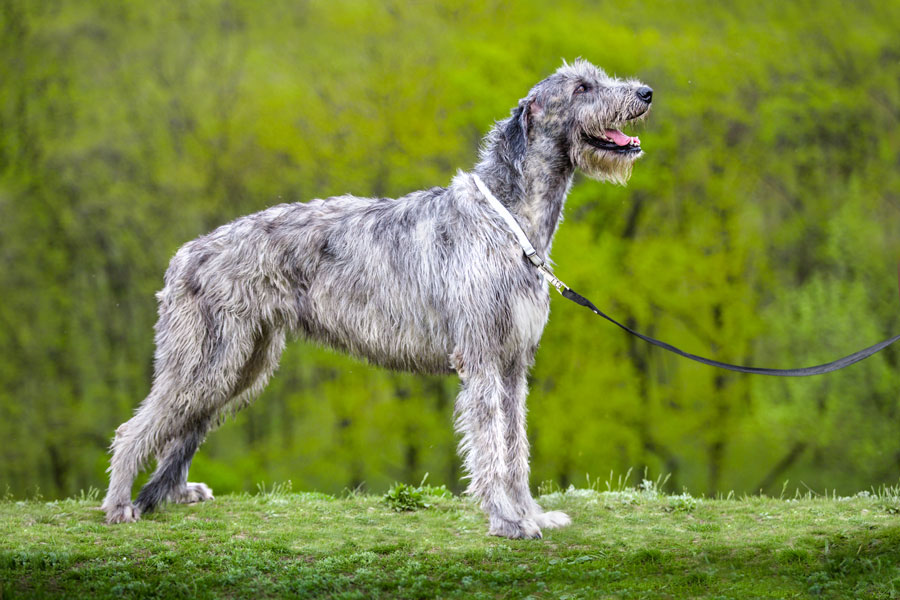
The Irish Wolfhound is a giant, rough-coated sighthound built for speed, strength, and endurance.
- Height:
- Males: 32+ inches (81+ cm)
- Females: 30+ inches (76+ cm)
- Note: The AKC disqualifies dogs under these minimums
- Weight:
- Males: 120–180 lbs (54–82 kg)
- Females: 105–140 lbs (48–64 kg)
- Coat: Harsh, wiry, and medium-length—about 2–4 inches on body; softer on head and ears
- Colors:
- Gray (most common)
- Brindle, red, black, white, fawn
- Note: All colors are accepted; no disqualifications
- Build: Muscular yet streamlined; deep chest, tucked abdomen, long neck
- Eyes: Dark brown or hazel—never light
- Tail: Long, slightly curved, carried low
- Movement: Effortless, ground-covering gallop—designed for chasing large prey over open terrain
Comparison: More massive and powerful than the Scottish Deerhound, and more rugged than the Great Dane.
Temperament & Personality
The Irish Wolfhound is dignified, gentle, and deeply loyal—a true aristocrat of temperament.
- Affection: Quietly devoted; leans, follows, and rests near family
- Calmness: Exceptionally serene indoors—often called “couch potatoes on stilts”
- Trainability: Intelligent but sighthound-independent—responds to calm, positive methods
- Prey drive: Very high—will chase squirrels, deer, or fast-moving objects if off-leash
- Sociability: Good with respectful children and calm adults; reserved but not shy with strangers
Myth debunked: Despite its size, the Irish Wolfhound is not aggressive—it’s one of the most trustworthy giant breeds with families.
Compared to the Great Dane, the Wolfhound is more reserved and less people-pleasing; compared to the Borzoi, it’s more adaptable to family life.
Care Requirements
Exercise
Needs 60–90 minutes of daily exercise, including:
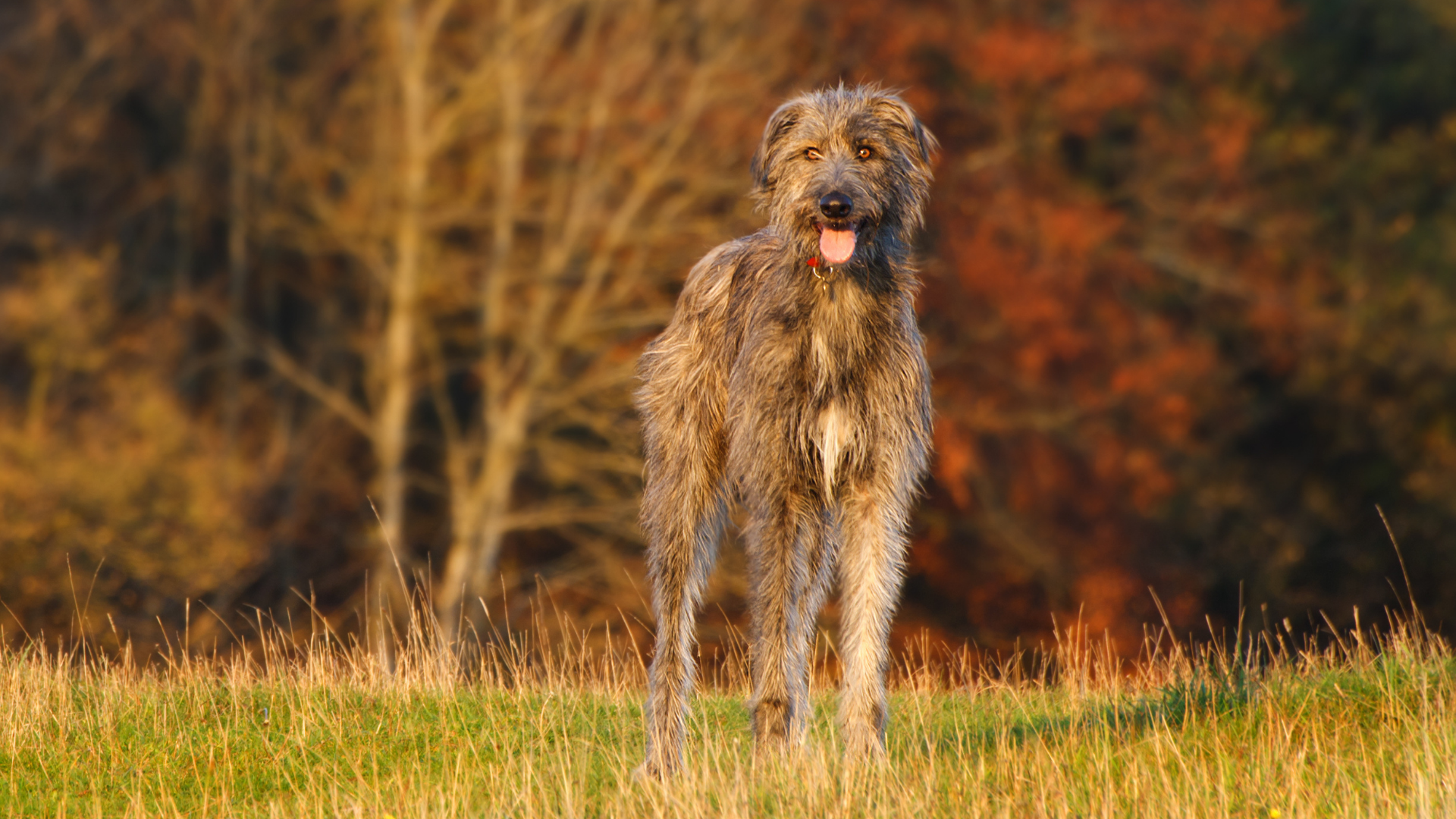
- Long walks or off-leash sprinting in a secure, high-fenced area (minimum 6 ft)
- Never trust off-leash in open areas—prey drive is overwhelming
- Mental stimulation: scent games or gentle obedience
Without sprint opportunities, may become restless or destructive.
Grooming
- Moderate shedding—brush 2–3 times weekly with a pin brush or comb
- Hand-stripping 2–3 times/year to maintain coat texture
- Bathe only as needed (2–4 times/year)—over-bathing softens coat
- Trim nails regularly; clean ears weekly
Note: The wiry coat traps dirt and burrs—check after outdoor time.
Diet
High-quality, large-breed puppy formula until 18 months. Adult diet should be moderate-protein with joint support. Use slow-feeder bowls to prevent bloat.
Environment
Best in rural or suburban homes with secure fencing. Not ideal for apartments unless heavily exercised. Tolerates cool climates well; provide shade in heat.
Health & Lifespan
Average lifespan: 6–8 years (AKC, IWCA)—one of the shortest among purebreds, largely due to size-related stress.
Condition | Description | Prevalence | Symptoms / Notes |
|---|---|---|---|
Osteosarcoma | Bone cancer | Extremely high risk (leading cause of death) | Lameness, swelling; aggressive and often fatal |
Dilated Cardiomyopathy (DCM) | Enlarged, weak heart | High risk | Lethargy, coughing; annual cardiac screening essential |
Twisted stomach | High risk (deep-chested giant) | Retching without vomiting—life-threatening emergency | |
Malformed hip joint | Moderate (OFA: ~15% affected) | Lameness; screen breeding stock | |
Anesthetic Sensitivity | Due to low body fat | High risk | Requires sighthound-safe protocols; avoid acepromazine |
IWCA strongly recommends annual cardiac (echo) exams and early cancer screening.
Responsible breeders test for DCM, hips, and thyroid—never buy from those who skip screening.
Training & Socialization
The Irish Wolfhound is intelligent but independent—it will obey if it sees value in it.
- Start socialization before 14 weeks: expose to people, dogs, sounds
- Use positive reinforcement with high-value rewards (chicken, cheese)
- Focus on recall, “leave-it,” and impulse control
- Never use punishment—this sensitive dog shuts down or becomes fearful
Warning: An unsocialized Wolfhound can become shy or overly reserved.
Suitability: Ideal Owner Profile
The Irish Wolfhound thrives with:
- Experienced giant-breed owners
- Calm, quiet households with predictable routines
- Secure rural or suburban homes with high fencing
- Owners who value elegance, history, and quiet loyalty
Not recommended for:
- First-time owners unprepared for prey drive
- Chaotic or noisy families
- Homes with small pets (unless raised together)
- Hot, humid climates without accommodations
Perfect for: Singles, couples, or retirees wanting a gentle, majestic companion with Celtic soul.
Costs & Commitment
- Adoption: Rare; available via sighthound rescues ($300–$800)
- Reputable breeder: $2,000–$3,500 (health-tested, IWCA-affiliated)
- Monthly expenses: $120–$200 (food, grooming, preventatives)
- Special costs: Fencing, cardiac screening, orthopedic beds, emergency fund
Lifetime cost estimate: $25,000–$35,000 over 7 years

Ethical Adoption vs. Breeder Guidance
Due to its rarity and health risks, ethical breeding is critical. Choose breeders who:
- Perform OFA cardiac, hip, and eye clearances
- Raise puppies in-home with early socialization
- Belong to the Irish Wolfhound Club of America (IWCA)
Avoid breeders who lack health testing or market “rare colors.”
FAQs
1. Is the Irish Wolfhound a giant dog?
Yes—the Irish Wolfhound is a giant breed, typically 30–32+ inches tall and 105–180+ lbs.
2. Are Irish Wolfhounds good with kids?
With older, respectful children—yes. Not suited for toddlers due to size.
3. Do Irish Wolfhounds shed a lot?
Moderately—weekly brushing manages it.
4. Irish Wolfhound vs. Great Dane: what’s the difference?
Wolfhound is more rugged, rough-coated, and reserved; Great Dane is smoother, more outgoing, and shorter-lived.
5. How rare is the Irish Wolfhound?
Rare—fewer than 300 AKC registrations annually in the U.S.
6. Are Irish Wolfhounds aggressive?
No—they’re among the gentlest giant breeds, though protective of family.
7. Can Irish Wolfhounds live in apartments?
Only with rigorous daily exercise and secure sprint space—not ideal.
8. What’s the #1 health risk for Irish Wolfhounds?
Osteosarcoma (bone cancer)—often fatal despite treatment.
Final Verdict: Is the Irish Wolfhound Right for You?
Yes, if…
- You want a giant, gentle, majestic companion with ancient Irish roots
- You can provide secure space, calm environment, and health vigilance
- You value dignity, loyalty, and quiet affection
- You’re prepared for a short but noble life
No, if…
- You seek a long-lived or low-cost pet
- You live in chaos or with small pets
- You can’t handle giant-breed health risks or prey drive
- You want a highly obedient or playful dog
The Irish Wolfhound isn’t just a dog—it’s a living legend of Celtic grace, offering serene strength and unwavering loyalty to those who earn its quiet trust.
Want to learn more?
Discover how Irish Wolfhounds are inspiring new approaches to canine palliative care and end-of-life dignity.