
Sloughi: Complete Guide to Temperament, Health, Care & History
Imagine a dog sculpted by the wind and sand of the Sahara—graceful, silent, and fiercely loyal. That’s the Sloughi, a large sighthound revered for over 2,000 years by Berber and Bedouin tribes across Morocco, Algeria, Tunisia, and Libya. Often mistaken for its cousin the Azawakh, the Sloughi is softer in expression, more athletic in build, and slightly more affectionate—yet equally rare and dignified.
If you’re drawn to primitive breeds with deep cultural roots, this guide delivers comprehensive, vet-verified insights into the Sloughi’s origin, personality, health, and daily care. You’ll learn how it compares to similar sighthounds like the Azawakh and Saluki, what health conditions to monitor, and whether your lifestyle aligns with this noble desert hunter.
Backed by the Fédération Cynologique Internationale (FCI), American Kennel Club (AKC), Orthopedic Foundation for Animals (OFA), and North African breed preservation societies, this article cuts through myth and marketing to offer authoritative, practical knowledge—perfect for potential owners, researchers, or sighthound enthusiasts.
Origin & History
The Sloughi (pronounced sloo-gee) is one of the world’s oldest sighthound types, with historical references dating back to Pharaonic Egypt and Roman North Africa. Unlike modern breeds shaped by kennel clubs, the Sloughi was refined by nomadic tribes who valued it as a hunter of gazelle, hare, and fox, as well as a guardian of camp and family.
In Berber culture, the Sloughi was never “just a dog”—it was a symbol of honor, nobility, and trust. Owners often shared meals and tents with their Sloughis, a testament to their deep bond.
The breed remained largely unknown outside North Africa until the 20th century. France began importing Sloughis in the 1920s, but numbers dwindled due to war and disease. A second wave of imports in the 1970s—led by dedicated enthusiasts—revived global interest. The FCI recognized the Sloughi in 1956, and the AKC granted full recognition in 2016.
Unlike the Azawakh, which comes from the Sahel (south of the Sahara), the Sloughi originates from the Maghreb (North Africa), giving it slightly different adaptations—thicker skin, more body fat, and a less extreme build.
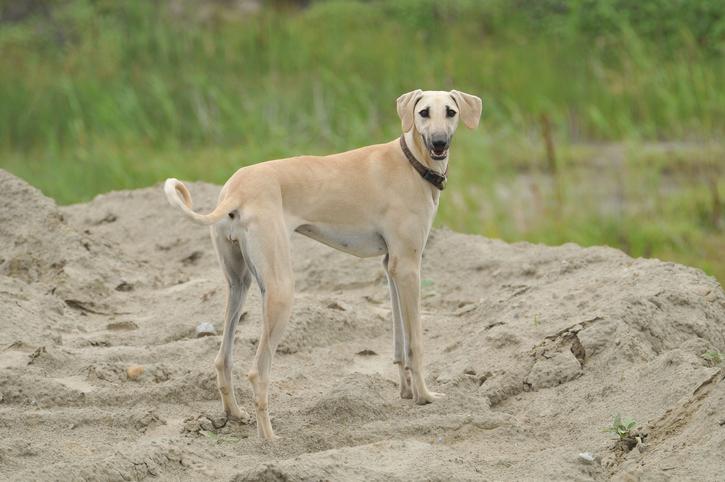
Key distinction: While both are desert sighthounds, the Sloughi is generally more robust and less angular than the Azawakh.
Physical Characteristics
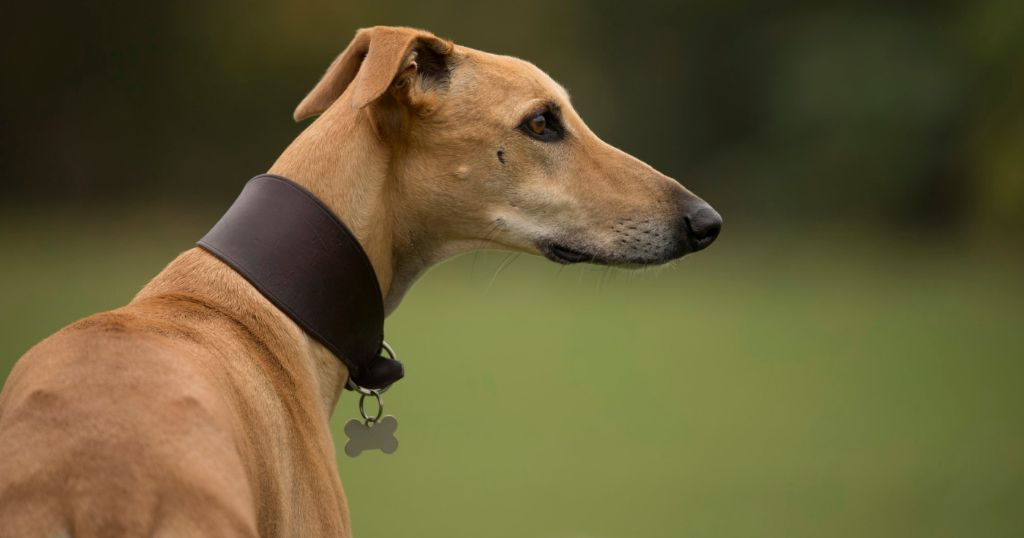
The Sloughi is a large, elegant sighthound built for speed, stamina, and endurance in rugged desert terrain.
- Height:
- Males: 26–28 inches (66–72 cm)
- Females: 24–27 inches (61–68 cm)
(Per AKC and FCI standards)
- Weight: 40–65 lbs (18–29 kg)—noticeably heavier than the leaner Azawakh
- Coat: Short, fine, and silky to the touch; slightly longer on the back of thighs
- Colors: Sand, red, fawn, or brindle, always with a black mask (a defining trait)
- Build: Athletic, with a deep but not overly narrow chest, visible musculature, and a tucked abdomen
- Eyes: Large, dark, and melancholic—often described as “soulful”
- Ears: Soft, medium-length, and carried close to the head
The Sloughi’s tail is low-set and carried saber-like, unlike the Azawakh’s high-set tail. Its movement is smooth and ground-covering, with tremendous reach.
Comparison: The Sloughi shares the Saluki’s flowing grace but has a more muscular frame and lacks feathering—making it better suited to rough, dry landscapes.
Temperament & Personality
The Sloughi is loyal, sensitive, and quietly affectionate with its family—but reserved with strangers. This is not a dog that greets guests with wagging enthusiasm; it observes, assesses, and bonds selectively.
- Attachment: Forms intense, one-or-two-person bonds; may suffer from separation anxiety
- Alertness: Naturally vigilant; will alert to unusual sights or sounds
- Gentleness: With trusted humans, especially children it’s raised with, it’s calm and patient
- Prey drive: Extremely high; will chase anything that runs
- Dignity: Dislikes being scolded or handled roughly; responds to calm, consistent leadership
Unlike the more independent Azawakh, the Sloughi often seeks physical closeness—leaning against legs or resting a chin on a knee. Yet it’s less exuberant than the Whippet and far more serious than the Italian Greyhound.
Note: Early socialization is non-negotiable. Without it, shyness or suspicion can develop.
Care Requirements
Exercise
The Sloughi needs daily vigorous exercise—ideally 45–60 minutes of running in a secure, enclosed area. Fenced yards must be minimum 6 feet tall and dig-proof; this breed can scale fences and vanish in seconds.
Despite its energy, it’s calm indoors and thrives as a house dog.
Grooming
Minimal. Weekly brushing suffices. Baths only when necessary—its skin is sensitive. Regular dental care and nail trims are essential.
Diet
High-quality, moderate-protein, grain-inclusive or grain-free diets (based on individual tolerance) work well. Due to moderate body fat, the Sloughi is less sensitive to anesthesia than the Azawakh, but caution is still advised.
Environment
Prefers warm, dry climates but adapts to temperate zones with indoor living. Not suited to prolonged outdoor living or extreme cold—winter coats are recommended below 40°F (4°C).
Comparison: Like the Saluki, the Sloughi adapts well to suburban life if exercise needs are met—but unlike the Saluki, it’s less tolerant of chaotic households.
Health & Lifespan
Average lifespan: 12–16 years (AKC, FCI)
The Sloughi benefits from centuries of natural selection, resulting in strong overall health. However, as the global population grows, certain inherited conditions are emerging.
Condition | Description | Prevalence in Sloughi | Symptoms / Notes |
|---|---|---|---|
Addison’s Disease (Hypoadrenocorticism) | Adrenal gland failure | Moderate risk (documented in U.S. and European lines) | Lethargy, vomiting, weakness; can be life-threatening if undiagnosed |
Progressive Retinal Atrophy (PRA) | Degenerative eye disease leading to blindness | Low but present | Night blindness first; genetic testing available (OptiGen) |
Gastric Dilation-Volvulus (Bloat) | Twisted stomach | Low risk (due to narrower chest than deep-chested giants) | Still possible; feed multiple small meals, avoid exercise after eating |
Vaccine Sensitivity | Overreaction to certain vaccines | Anecdotal reports; not well-studied | Use minimal, core vaccines; discuss titer testing with vet |
Demodectic Mange | Immune-related skin mite overgrowth | Seen in stressed pups | Usually resolves with age and immune support |
OFA data shows <1% incidence of hip dysplasia in tested Sloughis—excellent for a large breed.
Reliable data on cardiac conditions like DCM in this breed is limited, though responsible breeders perform annual cardiac screenings as a precaution.
Training & Socialization
The Sloughi is intelligent but emotionally sensitive. Harsh corrections shut it down; positive reinforcement builds trust.
- Start socialization before 12 weeks: expose to sounds, surfaces, people, and other dogs
- Use high-value rewards: freeze-dried meat, cooked chicken
- Focus on recall and impulse control—critical given its prey drive
- Off-leash freedom is only safe in fully enclosed areas
Compared to the Azawakh, the Sloughi is slightly more biddable but still requires patient, experienced handling. Not ideal for novice owners.
Suitability: Ideal Owner Profile
The Sloughi thrives with:
- Experienced dog owners who understand sighthound psychology
- Active, calm households with predictable routines
- Secure rural or suburban homes with large, fenced yards
- Owners who offer consistent companionship—this breed dislikes solitude
Not recommended for:
- First-time dog owners
- Homes with small pets (cats, rodents, etc.)
- Families with very young or boisterous children
- Urban apartments without access to safe sprint space
Like the Saluki, the Sloughi suits those who appreciate quiet elegance and deep loyalty over constant playfulness.
Costs & Commitment
- Adoption: Extremely rare; few rescues specialize in Sloughis. Possible via sighthound networks ($500–$1,200)
- Reputable breeder: $2,000–$3,500 (health-tested, ethically raised)
- Monthly expenses: $85–$130 (premium food, supplements, preventatives)
- Special costs: Fencing, winter clothing, vet familiar with sighthounds
Lifetime cost estimate: $22,000–$30,000 over 14 years
Ethical Adoption vs. Breeder Guidance
Due to its rarity, ethical breeding is critical. Choose breeders who:
- Perform OFA thyroid, cardiac, and eye certifications
- Offer PRA genetic testing (via OptiGen or similar)
- Raise puppies in-home with early socialization
- Belong to the Sloughi Club of America (SCA) or FCI-affiliated clubs
Avoid anyone selling “rare exotic” puppies online or without health documentation. The Sloughi’s future depends on preserving its health and heritage, not just its looks.
FAQs
1. Is the Sloughi a large dog?
Yes—the Sloughi is a large sighthound, typically 24–28 inches tall and 40–65 lbs.
2. Are Sloughis good with other dogs?
Often yes—if raised together. Adult introductions require caution due to prey drive.
3. Do Sloughis shed?
Minimally. Their short coat sheds lightly year-round.
4. How much exercise does a Sloughi need?
Daily high-speed runs in a secure area—plus leash walks. Mental stimulation is also important.
5. Can Sloughis live in cold climates?
Only with indoor access and winter coats. They lack insulating fat.
6. Are Sloughis aggressive?
No—but they are reserved with strangers and protective of their family.
7. Sloughi vs. Azawakh: which is better?
The Sloughi is slightly more affectionate and robust; the Azawakh is more aloof and refined. Choice depends on lifestyle.
8. How rare is the Sloughi?
Very. Fewer than 200 are registered annually in the U.S. (AKC).
Final Verdict: Is the Sloughi Right for You?
Yes, if…
- You seek a large, elegant, loyal companion with ancient roots
- You can provide secure space for sprinting and consistent companionship
- You’re experienced with sighthounds or sensitive breeds
- You value quiet dignity over constant interaction
No, if…
- You want a playful, child-centered family dog
- You live in a small apartment or cold climate without accommodations
- You expect off-leash reliability or tolerance of small animals
- You’re a first-time owner
The Sloughi is more than a pet—it’s a living heirloom of North African desert culture, offering silent loyalty and breathtaking grace to those who earn its trust.