
Komondor: Complete Guide to Temperament, Health, Care & History
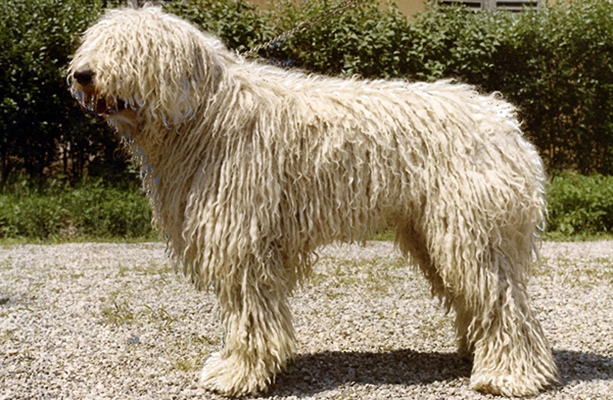
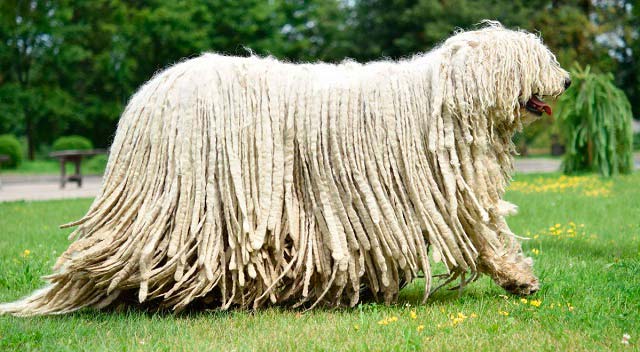
Standing over 27 inches tall and cloaked in a thick, floor-length coat of dreadlock-like cords, the Komondor looks less like a dog and more like a moving sheep—or a mythical beast from folklore. Pronounced KOH-mon-dor, this giant Hungarian livestock guardian was bred for centuries to protect flocks from wolves and bears in the Carpathian Basin.
Nicknamed the “mop dog” for its unique appearance, the Komondor is not a novelty pet. Behind its striking coat lies a fearless, independent, and deeply loyal guardian with an innate sense of duty, territorial awareness, and calm authority.
While rare outside Hungary—fewer than 300 are registered annually in the U.S. (AKC)—the Komondor remains a working dog in its homeland, where it still patrols pastures with silent vigilance.
In this comprehensive, rigorously researched guide, you’ll learn everything about the Komondor: its ancient origins, unique corded coat, temperament as a guardian, health vulnerabilities, intensive grooming needs, and whether your lifestyle can meet the demands of this noble giant. We’ll also compare it to similar livestock guardians like the Kuvasz, Tibetan Mastiff, and Anatolian Shepherd to clarify its role among protective breeds.
All information is verified through the American Kennel Club (AKC), Fédération Cynologique Internationale (FCI), Hungarian Komondor Club, Orthopedic Foundation for Animals (OFA), and international working-dog experts.
Origin & History
The Komondor’s roots trace back over 1,000 years to the Magyar tribes who migrated into the Carpathian Basin (modern-day Hungary) in the 9th century. These nomadic shepherds brought large, white livestock guardian dogs with them—ancestors of today’s Komondor.
Unlike herding dogs (like Border Collies), the Komondor was a livestock guardian: it lived with the flock, not driving it. Its job was to deter, confront, or kill predators like wolves, bears, and thieves—often working alone at night.
Historical records from the 1544 Hungarian codex describe the Komondor as “a dog of great strength and courage,” and it has remained largely unchanged in form and function for centuries.
The breed was recognized by the AKC in 1937 but remains rare globally. In Hungary, it’s a national treasure—protected by cultural and agricultural programs.
Key distinction: The Komondor shares its Hungarian homeland with the Kuvasz, but the Kuvasz is faster, more refined, and less aggressive—while the Komondor is a stationary, confrontational guardian.
Physical Characteristics
The Komondor is a giant, robust, and powerful dog built for endurance and protection—not speed or elegance.
- Height:
- Males: 27.5+ inches (70+ cm)
- Females: 25.5+ inches (65+ cm)
(Per AKC; dogs under standard are disqualified)
- Weight:
- Males: 100–130+ lbs (45–59+ kg)
- Females: 80–100+ lbs (36–45+ kg)
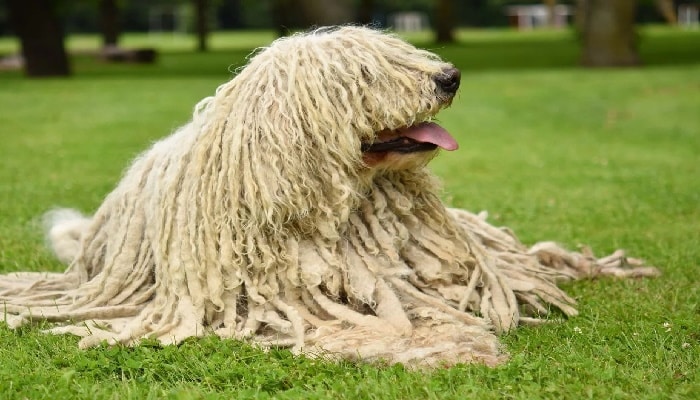
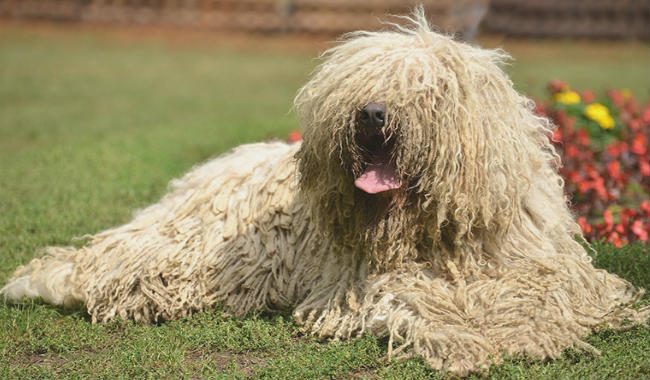
- Coat: Unique corded double coat—woolly undercoat and coarser outer coat naturally mat into dreadlock-like cords that grow to the ground
- Color: Pure white only—any other color is disqualification
- Build: Muscular neck, broad chest, strong bone, and a level topline
- Eyes: Small, almond-shaped, dark brown—hidden under cords but intensely alert
- Tail: Long, carried low with a slight curve at rest; raised when alert
Its movement is powerful, unhurried, and deliberate—built for patrolling, not sprinting.
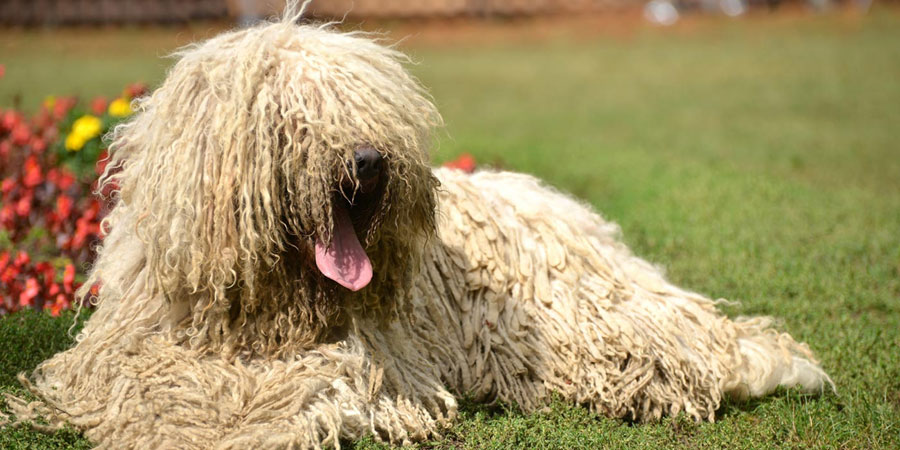
Comparison: Unlike the Tibetan Mastiff (which has a mane and loose skin) or Anatolian Shepherd (shorter coat), the Komondor’s corded coat is its defining trait—evolved to protect against bites and weather.
Temperament & Personality
The Komondor is calm, courageous, and fiercely protective—but not aggressive without cause. It is a thinking guardian, assessing threats before acting.
- Loyalty: Devoted to family and flock; bonds deeply with its territory
- Independence: Bred to work alone—makes decisions without human input
- Alertness: Extremely watchful; will confront intruders (human or animal)
- Stability: Confident and steady when properly socialized
- Trainability: Not eager to please—respects calm, consistent leadership but resists coercion
Critical note: The Komondor is not a “family pet” in the conventional sense. It is a working guardian first. Without proper upbringing, it can become overprotective, territorial, or aggressive.
Compared to the Kuvasz (more playful and people-oriented) or Great Pyrenees (more tolerant of strangers), the Komondor is less forgiving and more confrontational.
Care Requirements
Exercise
Needs 60–90 minutes of daily exercise, but not high-intensity:
- Long walks, property patrols, or supervised yard time
- No off-leash freedom—strong territorial instinct
- Mental stimulation: boundary training, visitor protocols
Over-exercising puppies can damage joints—keep activity moderate until 18 months.
Grooming
Extremely high maintenance—the corded coat requires lifelong commitment:
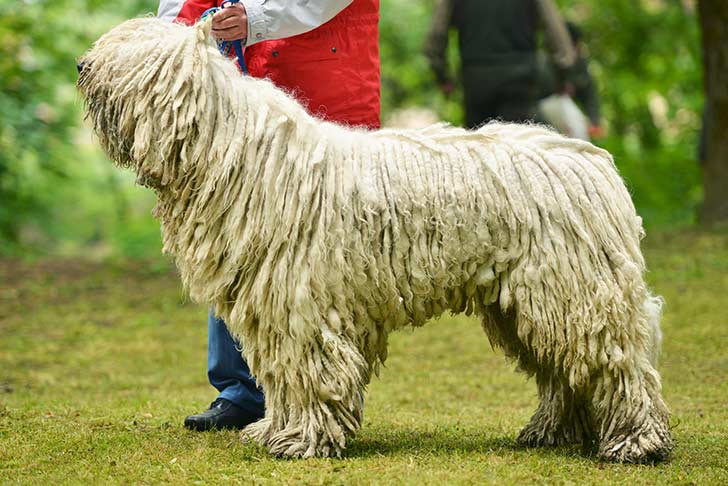
- Cording process: Begins at 8–12 months; cords must be separated by hand weekly to prevent giant mats
- Drying: After rain or baths, cords take 24–48 hours to dry—risk of mildew or skin infection
- Bathing: Every 3–6 months (takes 4+ hours to wash and dry)
- Hygiene: Trim cords around paws, eyes, and rear for cleanliness
- Never shave—exposes skin to sunburn and injury
Myth: The coat is not “low maintenance”—it’s one of the most labor-intensive in the dog world.
Diet
High-quality, moderate-protein diet with joint support. Due to size, slow-feeder bowls are essential to prevent bloat. Monitor weight—obesity worsens joint stress.
Environment
Best in rural or suburban homes with large, securely fenced acreage. Not suited for apartments, cities, or homes with frequent strangers. Thrives in temperate or cool climates; cords provide insulation but limit heat tolerance.
Health & Lifespan
Average lifespan: 10–12 years (AKC, OFA)
As a giant breed, the Komondor faces several inherited conditions.
Condition | Description | Prevalence | Symptoms / Notes |
|---|---|---|---|
Malformed hip joint | High risk (OFA: ~20% affected) | Lameness, stiffness; screen breeding stock | |
Twisted stomach | High risk (deep-chested giant) | Retching without vomiting—life-threatening emergency | |
Entropion/Ectropion | Eyelid malformation | Moderate (due to cords pulling skin) | Eye irritation; may require surgery |
Skin Infections | Due to trapped moisture in cords | Common if poorly maintained | Odor, redness, itching; prevent with drying |
Autoimmune Thyroiditis | Underactive thyroid | Reported in some lines | Weight gain, lethargy; manageable |
OFA data confirms Komondors have above-average hip dysplasia rates—ethical breeders must screen.
Reliable data on heart or cancer risks is limited, though responsible breeders perform annual vet checks.
Training & Socialization
Early, extensive socialization is non-negotiable (8–16 weeks):
- Expose to people, dogs, cars, children, and urban environments
- Teach boundary control—“stay on property” is critical
- Use positive reinforcement with firm consistency—never punishment
Obedience should focus on recall, “leave-it,” and calm behavior around guests.
Warning: An untrained Komondor is dangerous due to size, strength, and protective instinct.
Compared to the Anatolian Shepherd, the Komondor is less adaptable to multi-pet households and more likely to challenge authority.
Suitability: Ideal Owner Profile
The Komondor thrives with:
- Experienced livestock guardian owners
- Rural property owners with flocks or large acreage
- Confident, calm leaders who understand guardian psychology
- Owners committed to lifelong grooming and training
Not recommended for:
- First-time dog owners
- Urban or suburban families without space
- Homes with frequent visitors or shared fencing
- Anyone seeking a playful, obedient, or affectionate “companion”
Perfect for: Farmers, shepherds, or guardians who need a no-nonsense protector of land and livestock.
Costs & Commitment
- Adoption: Extremely rare; few rescues specialize in Komondors ($500–$1,200 if available)
- Reputable breeder: $1,800–$3,000 (health-tested, with working lineage)
- Monthly expenses: $120–$180 (large-dog food, grooming supplies, preventatives)
- Special costs: Professional grooming (optional), fencing, bloat-prevention bowls, drying equipment
Lifetime cost estimate: $28,000–$40,000 over 11 years
Ethical Adoption vs. Breeder Guidance
Due to its intensity, ethical breeding is critical. Choose breeders who:
- Perform OFA hip, cardiac, and eye clearances
- Raise puppies with livestock exposure
- Belong to the Komondor Club of America (KCA) or Hungarian clubs
- Do not sell to urban or inexperienced homes
Avoid breeders who market Komondors as “unique pets” without discussing guardian instincts and grooming demands.
FAQs
1. Is the Komondor a giant dog?
Yes—the Komondor is a giant breed, typically 25.5–27.5+ inches tall and 80–130+ lbs.
2. Are Komondors good with kids?
Only with older, respectful children in rural settings. Not suitable for toddlers or chaotic homes.
3. Do Komondors shed?
They don’t shed like other dogs—hair mats into cords. But cords require intensive maintenance.
4. Komondor vs. Puli: what’s the difference?
Puli is a small herding dog (25–35 lbs) with similar cords; Komondor is a giant guardian.
5. How rare is the Komondor?
Very rare—fewer than 300 AKC registrations annually in the U.S.
6. Are Komondors aggressive?
Not when properly bred and socialized—but they are highly territorial and protective.
7. Can you shave a Komondor?
Not recommended—the coat protects against weather, bites, and sun. Shaving risks injury and sunburn.
8. Do Komondors bark a lot?
They bark to alert or deter—not nuisance bark—but will sound the alarm for intruders.
Final Verdict: Is the Komondor Right for You?
Yes, if…
- You’re an experienced guardian dog owner with rural property
- You need a fearless, independent protector of livestock or land
- You can commit to lifelong cord maintenance and training
- You respect its instincts, not just its looks
No, if…
- You want a low-maintenance or urban pet
- You’re a first-time owner or seek a playful companion
- You can’t handle territorial behavior or intense grooming
- You bought it because it “looks like a mop”
The Komondor isn’t a costume—it’s a living fortress, bred for centuries to stand between flock and fang. Honor its purpose, or choose another breed.