

Alaskan Malamute: Complete Guide to Temperament, Health, Care & History
Forged in the frozen wilderness of northwestern Alaska, the Alaskan Malamute is more than a sled dog—it’s a living testament to human survival in the Arctic. Bred by the Mahlemut Inuit people over 2,000 years ago to haul heavy freight across glaciers and hunt seals and polar bears, this large, wolf-like spitz combines raw power, endurance, and surprising gentleness.
With its thick double coat, broad head, plumed tail, and soulful brown eyes, the Malamute captivates at first glance. But behind its majestic appearance lies a strong-willed, independent, and highly social dog that thrives on purpose, not pampering.
Unlike the faster Siberian Husky (bred for speed), the Malamute was built for strength and stamina—pulling 1,000+ pounds over miles of ice. Today, it remains one of the most physically powerful dog breeds, yet it’s also known for its affectionate, clownish side with family.
In this comprehensive, rigorously researched guide, you’ll learn everything about the Alaskan Malamute: its Indigenous origins, physical and temperamental traits, common health conditions, intensive grooming needs, exercise requirements, and whether your lifestyle aligns with this noble Arctic giant. We’ll also compare it to similar northern breeds like the Siberian Husky, Greenland Dog, and Samoyed to clarify its unique role among sled dogs.
All information is verified through the American Kennel Club (AKC), Alaskan Malamute Club of America (AMCA), Orthopedic Foundation for Animals (OFA), and Inuit cultural records.
Origin & History
The Alaskan Malamute descends from dogs bred by the Mahlemut people of the Kotzebue Sound region in northwestern Alaska. These Inuit relied on their dogs not just for transportation, but for survival—hunting marine mammals, hauling whale bones, and even sharing body heat in igloos.
Unlike modern breeds shaped by kennel clubs, the Malamute was refined by natural selection and functional necessity in one of Earth’s harshest environments. Its traits—thick coat, compact feet, and immense strength—were non-negotiable for Arctic life.
During the Klondike Gold Rush (1890s), Malamutes were in high demand as sled dogs. But crossbreeding with other breeds nearly erased pure lines. In the 1920s, Eleanor and Milton Seeley spearheaded a revival, and the AKC officially recognized the breed in 1935.
Key distinction: The Malamute is not a Husky. While the Siberian Husky was bred for speed and endurance over distance, the Malamute was bred for raw pulling power at slower speeds—like a canine tractor.
Physical Characteristics
The Alaskan Malamute is a large, powerfully built spitz designed for heavy freight hauling—not racing.
- Height:
- Males: 25 inches (63.5 cm)
- Females: 23 inches (58.5 cm)
(Per AKC standard; dogs over/under are penalized)
- Weight:
- Males: 85 lbs (38.5 kg)
- Females: 75 lbs (34 kg)
- Note: Weight should reflect lean muscle, not bulk
- Coat: Thick double coat—coarse, medium-length outer guard hairs with dense, woolly undercoat; sheds heavily twice a year
- Colors:
- Light gray to black, sable, red, buff, always with white underbody, face markings, and tail tip
- Note: Blue eyes are a disqualification—only brown eyes allowed
- Build: Broad head, strong neck, deep chest, and substantial bone; never refined or racy
- Tail: Heavily plumed, carried over the back like a banner
- Feet: Snowshoe-like—large, compact, and tough for ice travel
Its gait is steady, powerful, and tireless—built for all-day hauling, not sprinting.
Comparison: Larger and more robust than the Siberian Husky, and more powerful than the Samoyed—which was bred for herding and companionship, not freight.
Temperament & Personality
The Alaskan Malamute is affectionate, loyal, and playful with family—but independent and strong-willed in work.
- Energy level: High, but in bursts—enjoys “zoomies” followed by naps
- Affection: Deeply bonded; often “Velcro dogs” with their people
- Social nature: Not a guard dog—typically friendly with strangers (a trait valued by Inuit for safety in shared camps)
- Prey drive: Very high—will chase squirrels, cats, or deer
- Vocalization: Howls, sings, and “woo-woos”—rarely barks
- Intelligence: Smart but not eager to please—thinks independently
Myth debunked: Malamutes are not part wolf—they’re 100% domestic dog, though they resemble wolves due to convergent evolution.
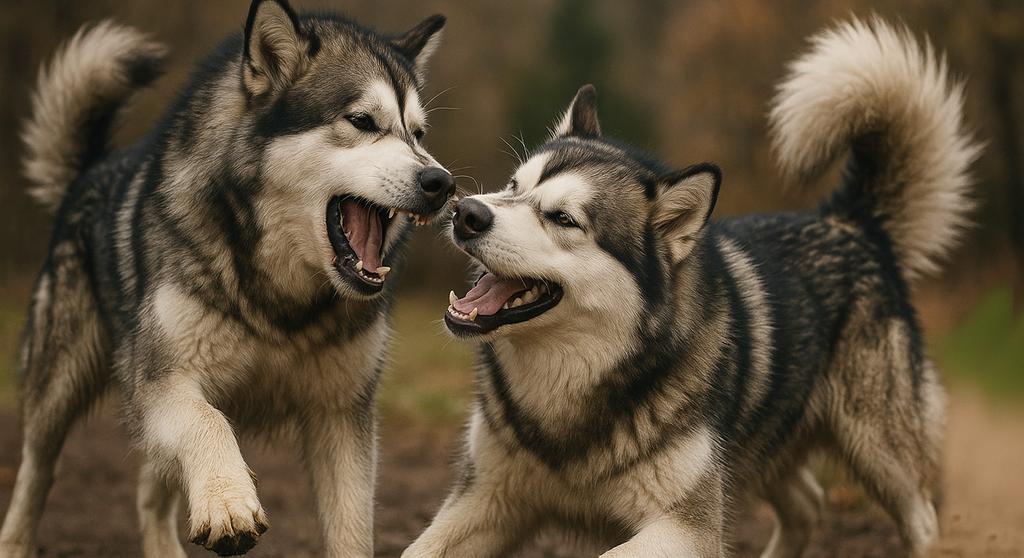
Compared to the Siberian Husky, the Malamute is less escape-prone but more dominant; compared to the Samoyed, it’s less people-pleasing but more physically powerful.
Care Requirements
Exercise
Needs 60–90 minutes of vigorous daily exercise, including:
- Long walks, hiking, or backpacking
- Weight-pulling or carting (ideal outlet for instinct)
- Off-leash play in fully secure areas only (prey drive is extreme)
Without purpose, may develop digging, howling, or escape behaviors.
Grooming
- Heavy seasonal shedder (“blows coat” twice a year—expect tumbleweeds of fur)
- Brush 2–3 times weekly (daily during shedding peaks)
- Never shave—coat insulates against heat and cold
- Bathe only as needed (2–4 times/year)
- Clean ears and trim nails regularly
Tip: A furminator or undercoat rake is essential during shedding season.
Diet
High-quality, moderate-protein diet with omega fatty acids for coat health. Due to Arctic origins, tolerates higher fat content—but monitor weight to avoid joint stress.
Environment
Best in cold or temperate climates; provide shade, water, and AC in heat. Adaptable to suburban homes with fencing. Not ideal for hot, humid regions.
Health & Lifespan
Average lifespan: 10–14 years (AKC, AMCA)
Generally robust, but some inherited conditions are documented.
Condition | Description | Prevalence | Symptoms / Notes |
|---|---|---|---|
Malformed hip joint | Moderate risk (OFA: ~18% affected) | Lameness, stiffness; screen breeding stock | |
Chondrodysplasia (Dwarfism) | Genetic skeletal disorder | Rare but serious | Short legs, deformed joints; DNA test available |
Underactive thyroid | Moderate | Weight gain, lethargy; manageable with medication | |
Twisted stomach | Possible (deep-chested) | Retching without vomiting—emergency | |
Inherited Polyneuropathy | Nerve degeneration | Rare (AMCA monitors) | Weakness, gait issues; genetic research ongoing |
AMCA mandates all breeding stock be tested for chondrodysplasia (via Paw Print Genetics) and OFA hip certification.
Reliable data on eye or heart issues is limited, though annual vet checks are recommended.
Training & Socialization
The Malamute is intelligent but stubborn—it will obey if it sees value in it.
- Start socialization before 16 weeks: expose to people, dogs, sounds
- Use positive reinforcement with high-value rewards (meat, cheese)
- Focus on recall, “leave-it,” and leash manners (strong puller)
- Never use punishment—this breed shuts down or becomes defiant
Compared to the Samoyed, the Malamute is less biddable; compared to the Husky, it’s more food-motivated but slower to recall.
Suitability: Ideal Owner Profile
The Alaskan Malamute thrives with:
- Active, experienced owners familiar with northern breeds
- Cold-climate households with secure fencing
- Families seeking a loyal, playful companion (with supervision due to size)
- Owners who enjoy outdoor adventures and canine sports
Not recommended for:
- First-time dog owners
- Hot, humid climates without accommodations
- Homes with small pets (unless raised together)
- Sedentary or frequently absent households
Perfect for: Hikers, mushers, backpackers, or families wanting a gentle giant with Arctic soul.
Costs & Commitment
- Adoption: Common via Malamute rescues ($300–$800)
- Reputable breeder: $1,500–$3,000 (health-tested, AMCA-affiliated)
- Monthly expenses: $100–$160 (food, grooming, preventatives)
- Special costs: Fencing, weight-pulling gear, undercoat tools, cooling mats
Lifetime cost estimate: $24,000–$35,000 over 12 years
Ethical Adoption vs. Breeder Guidance
Adoption is highly encouraged—many Malamutes end up in rescues due to unprepared owners.
If buying from a breeder:
- Demand OFA hip, chondrodysplasia DNA, and eye clearances
- Meet both parents (assess temperament)
- Choose breeders affiliated with the AMCA
- Avoid “rare color” or “giant Malamute” marketing—size and color don’t increase value
FAQs
1. Is the Alaskan Malamute a large dog?
Yes—the Alaskan Malamute is a large breed, typically 23–25 inches tall and 75–85+ lbs.
2. Are Malamutes good with kids?
Yes—with supervision. Their size and playfulness can knock over toddlers.
3. Do Malamutes shed a lot?
Yes—heavily twice a year; weekly brushing required.
4. Malamute vs. Husky: what’s the difference?
Malamutes are larger, stronger, slower, and brown-eyed only; Huskies are smaller, faster, and can have blue eyes.
5. How much exercise does a Malamute need?
60–90 minutes daily of physical + mental activity.
6. Are Malamutes part wolf?
No—they’re 100% domestic dog, though they resemble wolves.
7. Do Malamutes bark a lot?
No—they howl, sing, or “woo”, but rarely bark.
8. Can Malamutes live in hot climates?
Only with AC, limited exercise in cool hours, and close monitoring—not ideal.
Final Verdict: Is the Alaskan Malamute Right for You?
Yes, if…
- You want a large, loyal, powerful companion with Arctic heritage
- You can provide daily exercise, mental engagement, and cool climate
- You value independence, strength, and gentle affection
- You’re prepared for shedding, training patience, and lifelong care
No, if…
- You seek a low-maintenance or obedient “people-pleaser”
- You live in extreme heat without accommodations
- You can’t handle strong prey drive or howling
- You’re a first-time owner unprepared for giant-breed needs
The Alaskan Malamute isn’t just a pet—it’s a partner in adventure, a gentle giant of the North, and a living link to Inuit resilience.