

Basenji: Complete Guide to Temperament, Health, Care & History
With its wrinkled forehead, curled tail, and cat-like grooming habits, the Basenji looks like a creature from ancient Egypt—and for good reason. One of the world’s oldest dog breeds, the Basenji originated in Central Africa, where it hunted alongside pygmies in the Congo rainforest, using silent stalking and sharp eyesight to flush game into nets.
Often called the “barkless dog,” the Basenji doesn’t bark—but it yodels, screams, and chortles with surprising volume. Independent, intelligent, and fastidiously clean, this medium-sized sighthound-hound hybrid is as enigmatic as it is elegant. It forms deep bonds with its family but remains aloof with strangers, and its strong prey drive and independent mind make it a challenge for novice owners.
Yet for those who understand its nature, the Basenji offers loyalty, grace, and a touch of wild mystery—a living link to the dawn of dog domestication.
In this comprehensive, rigorously researched guide, you’ll learn everything about the Basenji: its African origins, unique vocalizations, cat-like temperament, common health conditions, grooming needs, and whether your lifestyle aligns with this ancient, independent breed. We’ll also compare it to similar primitive dogs like the Shiba Inu, Thai Ridgeback, and Pharaoh Hound to clarify its special place among barkless canines.
All information is verified through the American Kennel Club (AKC), Basenji Club of America (BCOA), Orthopedic Foundation for Animals (OFA), and African ethnographic records.
Origin & History
The Basenji’s roots trace back over 5,000 years to Central Africa, particularly the Congo Basin, where it was bred by Bantu-speaking peoples and pygmy tribes as a silent hunting companion. Cave paintings in Libya and Egyptian tombs depict dogs resembling the Basenji, suggesting it was known across ancient North Africa.
Unlike European hounds that bay, the Basenji was prized for its silence—essential for stealthy forest hunting. It would flush game silently while hunters waited with nets—a method still used today in remote regions.

The breed reached the West in the 1930s, though early imports died from disease. In 1941, a successful shipment of six Basenjis to England and the U.S. founded the modern gene pool. The AKC recognized the breed in 1943.
Key fact: The Basenji is not truly “barkless”—it simply lacks the larynx structure for a traditional bark. Instead, it yodels—a sound called the “baroo.”
Physical Characteristics
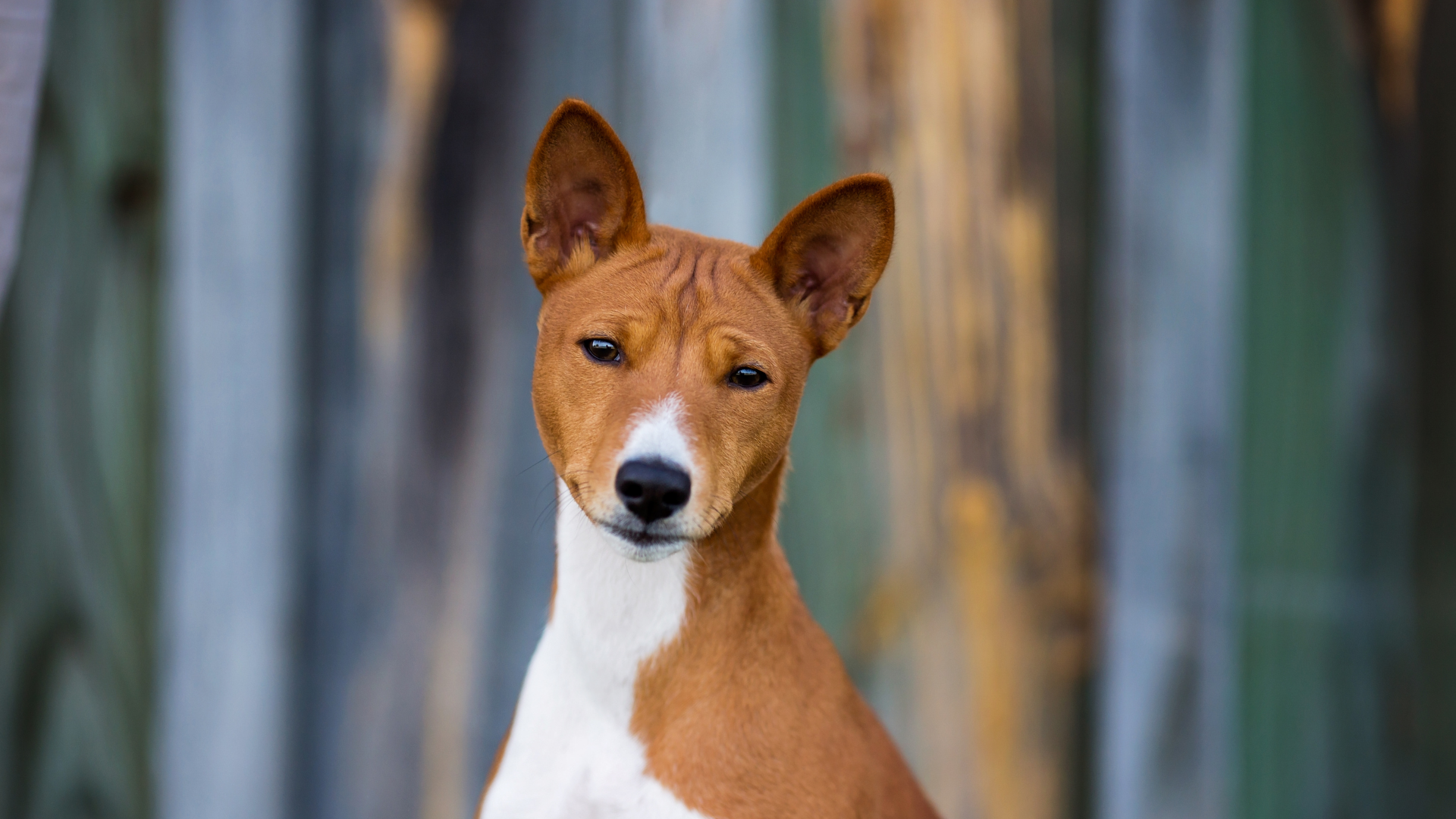
The Basenji is a medium-sized, square-proportioned, athletic dog built for speed and agility.
- Height:
- Males: 17 inches (43 cm)
- Females: 16 inches (41 cm)
- Weight:
- Males: 24 lbs (11 kg)
- Females: 22 lbs (10 kg)
- Coat: Short, fine, and glossy—lies flat against the body
- Colors:
- Chestnut red (most iconic)
- Black, brindle, tri-color (black, tan, white)
- All must have white feet, chest, and tail tip
- Build: Muscular neck, deep chest, tucked abdomen, and level topline
- Tail: Tightly curled over the hip—never loose
- Eyes: Almond-shaped, dark brown, with an alert, intelligent expression
- Forehead: Wrinkles when ears are erect—especially in puppies
Its movement is light, quick, and effortless—ideal for sudden sprints in dense brush.
Comparison: More primitive and independent than the Pharaoh Hound, and more vocal (in its own way) than the Shiba Inu.
Temperament & Personality
The Basenji is intelligent, independent, and cat-like—affectionate on its own terms, but not eager to please.
- Affection: Bonds deeply with family but may favor one person; shows love through proximity, not cuddling
- Cleanliness: Grooms itself like a cat—rarely has doggy odor
- Vocalization: Does not bark—instead, it yodels (“baroo”), screams, or chortles when excited
- Prey drive: Extremely high—will chase squirrels, birds, or cats if not contained
- Trainability: Stubborn and self-reliant—obeys only if it sees value in it
- Sociability: Reserved with strangers; good with respectful children
Myth debunked: Basenjis are not “quiet dogs”—they’re differently vocal. Their yodel can be surprisingly loud!
Compared to the Shiba Inu, the Basenji is more curious and less territorial; compared to the Thai Ridgeback, it’s more refined and less dominant.
Care Requirements
Exercise
Needs 60+ minutes of vigorous daily exercise:
- Brisk walks, hiking, or off-leash play in fully secure areas only
- Never off-leash in open areas—prey drive is overwhelming
- Mental stimulation: puzzle toys, scent games, or lure coursing
Without outlets, may develop digging, howling, or escape behaviors.
Grooming
- Very low maintenance: Weekly brushing suffices
- Bath only as needed (2–4 times/year)—natural oils keep coat healthy
- Clean ears and trim nails regularly
Note: The short coat sheds minimally—ideal for light shedders.
Diet
High-quality, moderate-protein diet with omega fatty acids. Avoid overfeeding—lean build hides fat easily.
Environment
Best in suburban or rural homes with secure fencing. Not ideal for apartments unless heavily exercised. Tolerates heat better than cold due to short coat.
Health & Lifespan
Average lifespan: 12–16 years (AKC, BCOA)—longer than many purebreds due to ancient genetics.
Condition | Description | Prevalence | Symptoms / Notes |
|---|---|---|---|
Fanconi Syndrome | Kidney tubule disorder | Breed-specific (DNA test available) | Excessive thirst/urination; manageable with early detection |
Degenerative eye disease | Moderate | Night blindness; genetic test available | |
Hypothyroidism | Underactive thyroid | Occasional | Weight gain, lethargy; manageable |
Immunoproliferative Small Intestinal Disease (IPSID) | Autoimmune gut disorder | Rare but serious | Chronic diarrhea; requires lifelong treatment |
BCOA mandates DNA testing for Fanconi and PRA—ethical breeders comply.
Reliable data on hip dysplasia is low—the breed is generally structurally sound.
Training & Socialization
The Basenji is intelligent but stubborn—it respects fairness, not force.
- Start socialization before 14 weeks: expose to people, dogs, sounds
- Use positive reinforcement with high-value rewards (chicken, cheese)
- Focus on recall, “leave-it,” and impulse control
- Never use punishment—this breed shuts down or becomes defiant
Warning: An unsocialized Basenji can become shy or overly independent.
Compared to the Pharaoh Hound, the Basenji is less biddable but more curious.
Suitability: Ideal Owner Profile
The Basenji thrives with:
- Experienced dog owners familiar with primitive breeds
- Active households that provide structure and exercise
- Homes with older children or single-dog families
- Owners who value independence, cleanliness, and minimal shedding
Not recommended for:
- First-time dog owners seeking an obedient pet
- Homes with small pets (unless raised together)
- Sedentary or frequently absent households
- Anyone annoyed by yodeling or strong will
Perfect for: Singles, couples, or remote workers wanting a clean, intelligent, low-shedding companion with ancient roots.

Costs & Commitment
- Adoption: Available via Basenji rescues ($300–$700)
- Reputable breeder: $1,800–$2,800 (health-tested, BCOA-affiliated)
- Monthly expenses: $60–$100 (food, grooming, preventatives)
- Special costs: Fencing, DNA health tests, professional training
Lifetime cost estimate: $15,000–$22,000 over 14 years
Ethical Adoption vs. Breeder Guidance
Choose breeders who:
- Perform DNA tests for Fanconi and PRA
- Raise puppies in-home with early socialization
- Belong to the Basenji Club of America (BCOA)
Avoid breeders who lack health testing or market “rare colors”—this breed’s longevity depends on ethical stewardship.
FAQs
1. Is the Basenji a medium dog?
Yes—the Basenji is a medium-sized breed, typically 16–17 inches tall and 22–24 lbs.
2. Are Basenjis good with kids?
With older, respectful children—yes. Not suited for toddlers due to sensitivity.
3. Do Basenjis bark?
No—they yodel (“baroo”), scream, or chortle instead.
4. Basenji vs. Shiba Inu: what’s the difference?
Basenji is more curious, less territorial, and barkless; Shiba is more reserved, vocal (screams), and independent.
5. How rare is the Basenji?
Uncommon—fewer than 1,000 AKC registrations annually in the U.S.
6. Are Basenjis hypoallergenic?
No—but they shed minimally and groom like cats, which may help some allergy sufferers.
7. Can Basenjis be left alone?
Yes—they’re independent and often enjoy quiet time (but still need daily interaction).
8. What’s the #1 health risk for Basenjis?
Fanconi Syndrome—but it’s manageable with early DNA testing and treatment.
Final Verdict: Is the Basenji Right for You?
Yes, if…
- You want a medium, clean, intelligent companion with ancient heritage
- You respect independence and don’t need constant affection
- You’re an experienced or patient owner with a sense of humor
- You can handle yodeling, prey drive, and strong will
No, if…
- You seek a highly obedient, cuddly, or low-maintenance pet
- You’re a first-time owner unprepared for stubbornness
- You have small pets or very young children
- You dislike dogs that “think for themselves”
The Basenji isn’t just a dog—it’s a living echo of the African forest, offering quiet loyalty and fiery independence to those who earn its trust.

Want to learn more?
Explore: how Basenjis are helping scientists decode the origins of dog domestication through ancient DNA.