

Finnish Spitz: Complete Guide to Temperament, Health, Care & History
In the silent forests of Finland, where snow blankets ancient pines for months each year, a small but mighty hunter once helped secure survival: the Finnish Spitz. With its flame-red coat, pricked ears, and bushy tail curled over its back, this medium-sized spitz looks like a fox—but its true magic lies in its voice.
Bred for centuries to “bark point” game birds—treeing capercaillie, grouse, and squirrels with a rapid, rhythmic bark—the Finnish Spitz is the only dog breed in the world whose primary hunting method is vocal, not silent. So distinctive is this trait that in 1993, Finland declared it the National Dog—a symbol of resilience, intelligence, and harmony with nature.
Today, the Finnish Spitz is cherished as both a working hunter and a lively, affectionate companion. But don’t let its cheerful face fool you: this is a vocal, independent, and highly alert dog that thrives on engagement, not idleness.
In this comprehensive, rigorously researched guide, you’ll learn everything about the Finnish Spitz: its Nordic origins, unique barking instinct, temperament, health considerations, grooming needs, and whether your lifestyle aligns with this spirited medium spitz. We’ll also compare it to similar breeds like the Shiba Inu, Kai Ken, and American Eskimo Dog to clarify its special role among northern dogs.
All information is verified through the Finnish Spitz Club of America (FSCA), American Kennel Club (AKC), Fédération Cynologique Internationale (FCI), and Finnish hunting archives.
Origin & History
The Finnish Spitz descends from spitz-type dogs brought to Finland by forest-dwelling tribes over 2,000 years ago. Isolated by geography and culture, the breed developed in near-purity, refined by Finnish hunters who valued its keen nose, agility, and unique barking style.

Unlike pointing breeds that freeze silently, the Finnish Spitz alerts hunters by barking rapidly at treed game—a method so effective that hunters could locate birds by sound alone through dense forest. This “bark point” is still judged in field trials today, with top dogs reaching 120+ barks per minute.
By the late 1800s, crossbreeding threatened the breed. In 1892, Finnish breeder Hugo Roos spearheaded preservation efforts, establishing the first standard. The breed reached the U.S. in the 1950s and was recognized by the AKC in 1993—the same year it became Finland’s National Dog.
Key fact: The Finnish name Suomenpystykorva means “Finnish prick-eared dog”—highlighting its defining silhouette.
Physical Characteristics
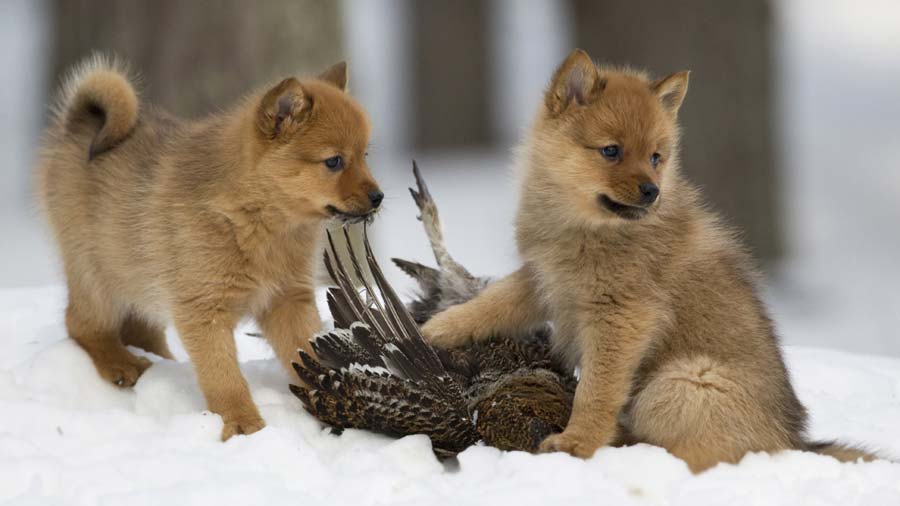
The Finnish Spitz is a light, square-built, fox-like spitz designed for agility and endurance in Nordic forests.
- Height:
- Males: 17.5–20 inches (44–51 cm)
- Females: 15.5–18 inches (39–46 cm)
- Weight:
- Males: 31–35 lbs (14–16 kg)
- Females: 21–28 lbs (9.5–12.7 kg)
- Coat: Double coat—medium-length, straight, and harsh outer guard hairs with soft undercoat; stands slightly off the body
- Color: Golden-red to honey-red only—any white or black markings are disqualifications
- Build: Light bone, deep chest, tucked abdomen, and level topline
- Tail: Profusely plumed, carried tightly curled over the back
- Eyes: Almond-shaped, dark brown, with an intelligent, alert expression
- Ears: Small, erect, and set high—extremely mobile
Its gait is light, quick, and effortless—ideal for covering ground silently before the bark begins.
Comparison: More vocal and people-oriented than the Shiba Inu, and less brindle-marked than the Kai Ken. Shares the American Eskimo Dog’s spitz elegance but with a hunting drive.
Temperament & Personality
The Finnish Spitz is lively, friendly, and vocal—a stark contrast to the aloofness of many spitz breeds.
- Affection: Warm and playful with family; often forms strong bonds with children
- Alertness: Extremely watchful; will bark at anything unusual—squirrels, mail carriers, falling leaves
- Vocalization: Very vocal by nature—not just in hunting, but at home (a major consideration for urban dwellers)
- Trainability: Intelligent and eager to engage, but easily bored by repetition
- Independence: Moderate—more biddable than the Shiba Inu, but still thinks for itself
Important: This breed needs early training to manage barking. Without it, the “bark point” instinct becomes a household nuisance.
Compared to the Shiba Inu (cat-like and reserved), the Finnish Spitz is more extroverted, social, and family-oriented.
Care Requirements
Exercise
Needs 60+ minutes of daily exercise:
- Brisk walks, hiking, off-leash play in secure areas
- Scent work, flirt pole, or mock bird trials to channel hunting instincts
- Mental challenges: puzzle toys, obedience games
Without stimulation, may develop excessive barking, digging, or chewing.
Grooming
- Moderate seasonal shedder (“blows coat” twice a year)
- Brush 2–3 times weekly (daily during shedding peaks)
- Bathe only as needed (2–4 times/year)—over-bathing strips natural oils
- Clean ears and trim nails regularly
Tip: A slicker brush keeps the harsh outer coat free of tangles without flattening its natural stand-off texture.
Diet
High-quality, moderate-protein diet with omega fatty acids for coat health. Monitor calories—active but prone to weight gain if under-exercised.
Environment
Best in suburban or rural homes with secure fencing. Not ideal for apartments or close-quarters living due to vocal nature. Tolerates cold well; provide shade in heat.
Health & Lifespan
Average lifespan: 12–15 years (AKC, FSCA)
Generally robust, but some inherited conditions are documented.
Condition | Description | Prevalence | Symptoms / Notes |
|---|---|---|---|
Patellar Luxation | Slipping kneecap | Moderate risk (common in medium spitz breeds) | Skipping gait; often mild |
Malformed hip joint | Low (OFA: ~5% affected) | Lameness; screen breeding stock | |
Epilepsy | Seizure disorder | Rare but reported | Sudden seizures; manage with medication |
Dental Issues | Crowded teeth or tartar buildup | Occasional | Regular brushing recommended |
Allergies / Atopy | Environmental sensitivities | Moderate | Itching, ear infections; often seasonal |
Finnish and U.S. breeders increasingly screen for patella (OFA) and epilepsy through the Finnish Spitz Health Database.
Reliable data on eye or heart issues is limited, though annual vet checks are recommended.
Training & Socialization
The Finnish Spitz is intelligent and responsive—but easily distracted.
- Start socialization before 14 weeks: expose to people, dogs, sounds, and urban stimuli
- Use positive reinforcement with high-value rewards (chicken, cheese)
- Focus on “quiet” command—essential for managing barking
- Keep sessions short, fun, and varied—boredom leads to shutdown
Warning: Harsh corrections backfire—this breed is sensitive and proud.
Compared to the American Eskimo Dog (more eager to please), the Finnish Spitz is more independent but equally trainable with patience.
Suitability: Ideal Owner Profile
The Finnish Spitz thrives with:
- Active families who enjoy outdoor activities
- Experienced or patient first-time owners prepared for vocalness
- Homes with secure yards away from close neighbors
- Owners who enjoy training, games, and canine communication
Not recommended for:
- Apartment dwellers in noise-sensitive buildings
- Sedentary or frequently absent households
- Homes seeking a quiet, low-energy dog
- People annoyed by frequent barking
Perfect for: Hunters, hikers, or families wanting a vocal, intelligent, fox-like companion with Nordic soul.
Costs & Commitment
- Adoption: Rare; few rescues specialize in Finnish Spitz ($400–$800 if available)
- Reputable breeder: $1,800–$2,800 (health-tested, FSCA-affiliated)
- Monthly expenses: $70–$110 (food, grooming, preventatives)
- Special costs: Fencing, training classes, bark-control tools
Lifetime cost estimate: $18,000–$25,000 over 13 years
Ethical Adoption vs. Breeder Guidance
Due to its rarity, ethical breeding is critical. Choose breeders who:
- Perform OFA patella, hip, and eye clearances
- Raise puppies in-home with early socialization
- Belong to the Finnish Spitz Club of America (FSCA) or Finnish kennel clubs
- Do not guarantee “quiet” puppies—barking is innate to the breed
Avoid breeders who downplay vocal tendencies or lack health testing.

FAQs
1. Is the Finnish Spitz a medium dog?
Yes—the Finnish Spitz is a medium-sized breed, typically 15.5–20 inches tall and 21–35 lbs.
2. Are Finnish Spitz good with kids?
Yes—they’re playful, patient, and social with respectful children.
3. Do Finnish Spitz bark a lot?
Yes—excessively. Barking is bred into their DNA; training can manage but not eliminate it.
4. Finnish Spitz vs. Shiba Inu: what’s the difference?
Finnish Spitz is more vocal, social, and family-oriented; Shiba is more independent, quiet, and reserved.
5. How rare is the Finnish Spitz?
Rare in the U.S.—fewer than 200 AKC registrations annually.
6. Are Finnish Spitz hypoallergenic?
No—they shed moderately, especially twice a year.
7. Can Finnish Spitz be left alone?
Only for moderate periods; they bond closely and may bark from boredom.
8. What is “bark pointing”?
A hunting method where the dog barks rapidly at treed game to alert the hunter—judged in field trials by speed and rhythm.
Final Verdict: Is the Finnish Spitz Right for You?
Yes, if…
- You want a medium, fox-like, intelligent companion with Nordic heritage
- You enjoy outdoor activities and vocal communication
- You can provide training, exercise, and noise-tolerant living
- You appreciate liveliness, loyalty, and a touch of wild spirit
No, if…
- You live in an apartment with thin walls
- You seek a quiet, low-maintenance dog
- You’re unprepared for daily barking and moderate shedding
- You dislike dogs that “talk back”
The Finnish Spitz isn’t just a pet—it’s a living echo of Finland’s forests, offering joyful noise and fiery loyalty to those who welcome its voice.